Every major storm teaches us something. The real question is whether we’re putting those lessons to work before the next one arrives.
Imagine getting a report card after every hurricane.
Not one with grades in math or science, but one showing exactly how your community performed when Mother Nature showed up for her toughest exam.
Which neighborhoods flooded first? Which roads became impassable? Which buildings held up? And why did one neighborhood escape serious damage while another, just a few miles away, suffered devastating losses?
Those are questions worth asking.
Because Florida has been taking this exam for a very long time.
And unfortunately, the tuition is getting awfully expensive.
Mother Nature doesn’t offer extra credit
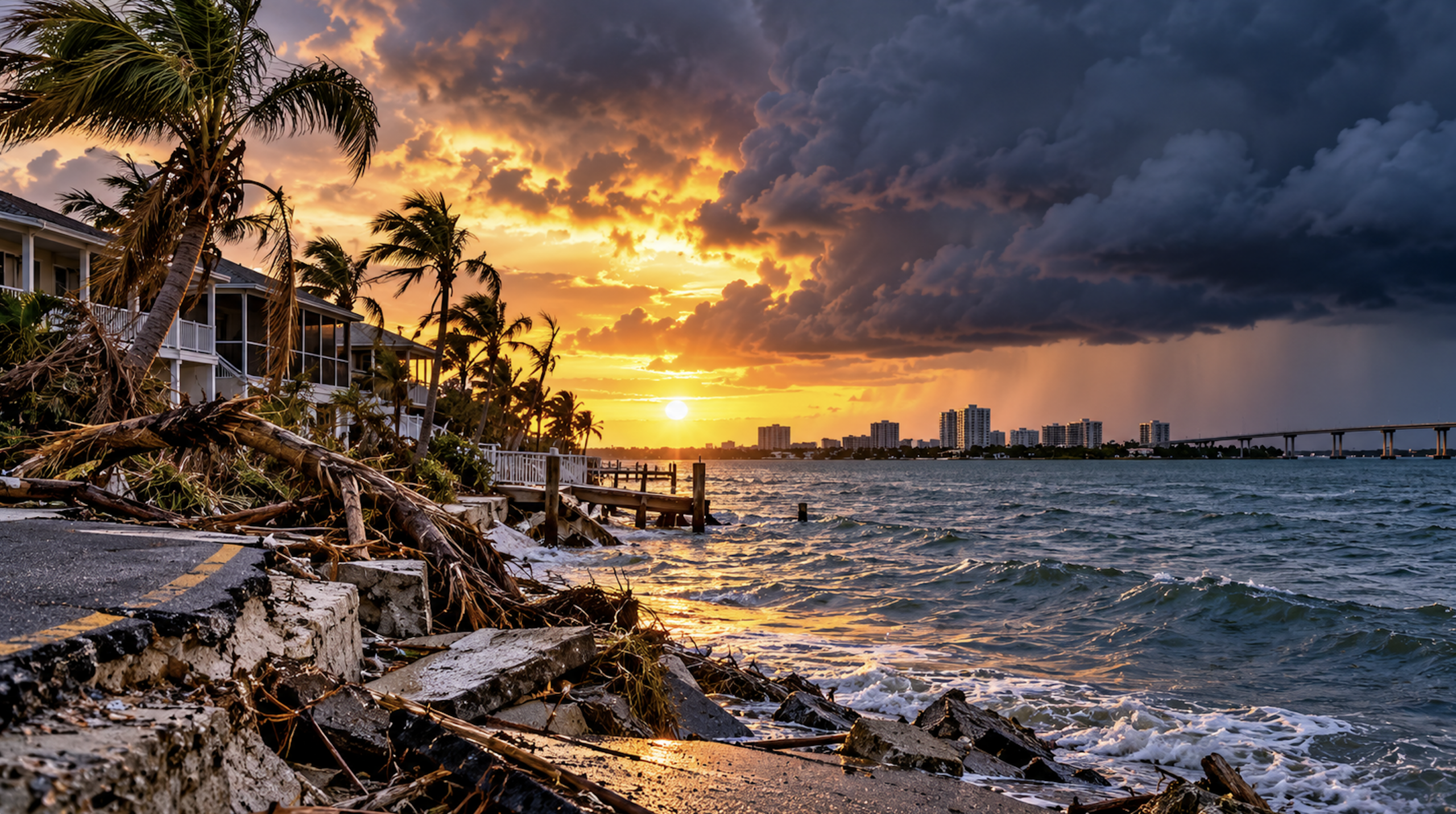
Think about the hurricanes that have affected Florida in recent years.
Ian. Idalia. Helene. Milton.
Different storms. Different tracks. Different impacts.
But each one exposed vulnerabilities that deserve our attention.
Sometimes it’s storm surge. Sometimes it’s rainfall. Sometimes it’s the wind. And sometimes it’s a combination of factors that nobody expected to come together quite the way they did.
We rebuild homes. Repair roads. Replace damaged infrastructure.
And eventually, life returns to something resembling normal.
But here’s a question we don’t ask nearly enough:
Are we rebuilding smarter, or simply rebuilding what we had before?
Because there’s a big difference.
What if our coastline could teach us something?
Imagine turning Sarasota Bay and the surrounding coastal communities into an enormous outdoor classroom.
Not the kind with desks and chalkboards.
This classroom would have sensors, monitoring equipment, advanced computer models, and researchers studying how the environment behaves in real time.
The tides become part of the lesson.
So does the rainfall.
And the groundwater. And the wind. And the way water moves through neighborhoods during extreme weather.
That’s the thinking behind the proposed Sarasota Living Laboratory for Coastal Resilience.
The idea is to learn more about how our coastal environment works, identify vulnerabilities, and explore better ways to prepare for the future.
It’s a fascinating concept because the laboratory isn’t separated from the community.
The community itself becomes part of the learning process.
Here’s the really interesting part
Most of us think of a major project as something with a beginning and an end.
You design it. Build it. Cut the ribbon.
Mission accomplished.
But science and technology don’t work that way.
Think about the smartphone you carried five years ago. At the time, it probably seemed pretty impressive.
Today? You might wonder how you ever survived with it.
Environmental technology is evolving, too.
Sensors are becoming more sophisticated. Computer models are improving. Artificial intelligence is opening new possibilities for understanding complex environmental systems.
So imagine a laboratory designed not just to use today’s technology, but to keep improving as new technology becomes available.
A laboratory that’s never really finished.
That’s what makes the word living so important.
Can we make Florida hurricane-proof?
No.
And anyone promising that probably has something to sell you.
We cannot stop hurricanes from forming. We cannot move the coastline farther inland. And we certainly cannot guarantee that every home and business will escape the next major storm.
But we can get better at understanding risks.
We can make more informed decisions about where and how we build.
We can improve infrastructure, strengthen preparedness, and use new scientific knowledge to help communities adapt.
That’s what resilience is really about.
Not eliminating every risk.
Getting better at managing the risks we know are coming.
A conversation worth having
On Thursday, November 12, the Climate Adaptation Center will bring together scientists, business leaders, policymakers, and community members for its 6th Annual Florida Climate Conference: From Climate Risk to Climate Resilience.
The conference will explore how Florida can move beyond simply recognizing climate-related challenges and begin putting practical solutions into action.
Among the ideas being discussed is the Sarasota Living Laboratory for Coastal Resilience.
And there are important questions ahead.
What could a project like this teach us? How could that knowledge benefit our communities? And how do we make sure today’s investments continue delivering value as technology evolves?
Those conversations matter whether you’re a scientist, a business owner, a homeowner, or someone who simply loves living in Florida.
Because here’s something we already know:
There will be another hurricane.
And another after that.
Mother Nature will keep giving us exams.
The question is whether we’ll be better prepared for the next one.
Be part of the conversation
6th Annual Florida Climate Conference: From Climate Risk to Climate Resilience
Thursday, November 12, 2026
Selby Auditorium
New College of Florida, Sarasota
Register today:
https://theclimateadaptationcenter.networkforgood.com/events/103790-6th-annual-cac-florida-climate-conference-from-climate-risk-to-climate-resilience