
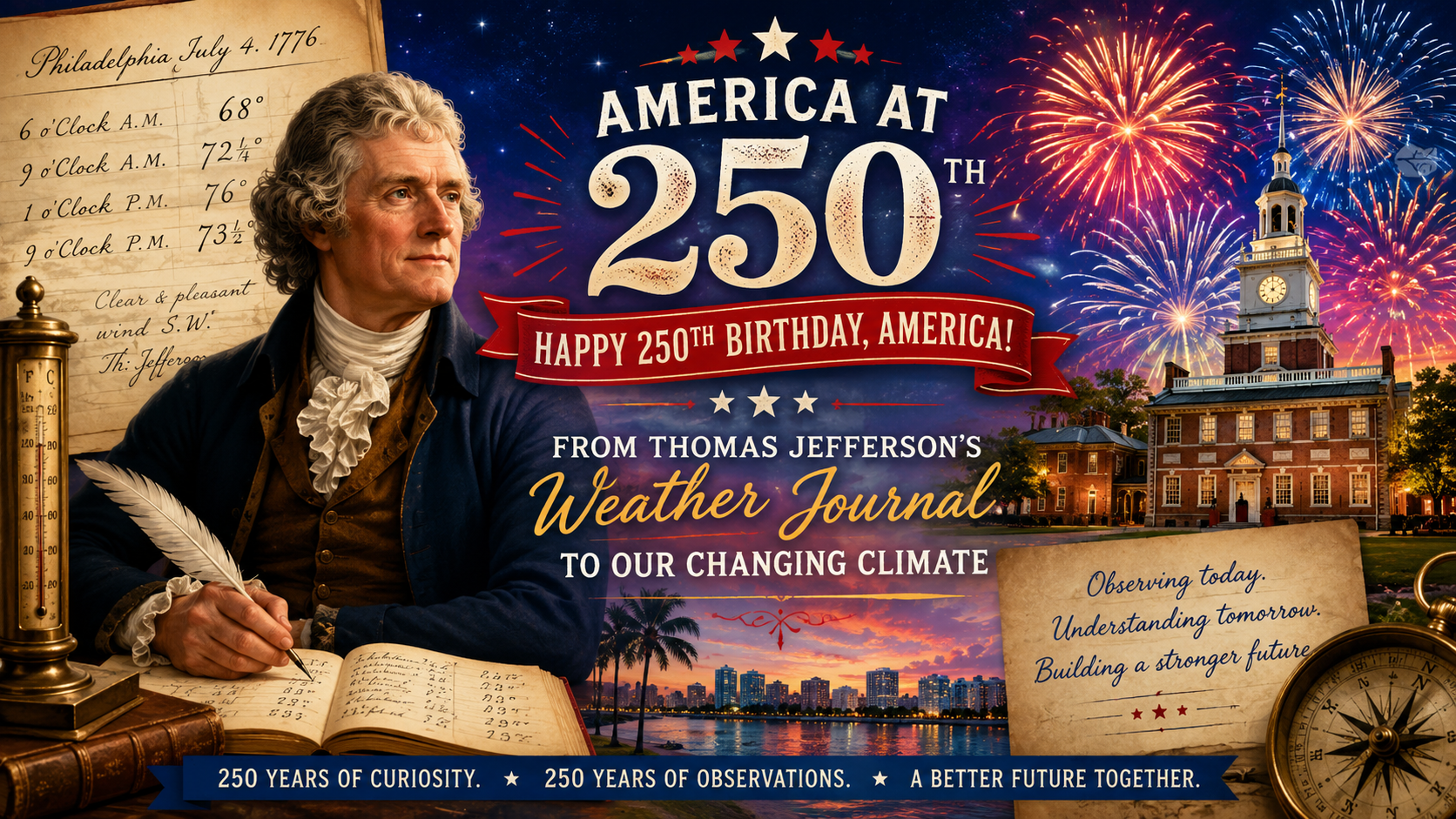
Can a weather journal from 250 years ago still help us understand our climate today? Yes. Thomas Jefferson’s weather journal provides one of America’s earliest long-term weather records, giving scientists a valuable glimpse into the atmosphere at the birth of our nation and helping lay the foundation for centuries of weather and climate observations.
Happy 250th birthday, America
Tomorrow, America celebrates its 250th birthday. Across the country, families will gather for parades, backyard cookouts, fireworks, and celebrations marking a quarter millennium of independence.
As we celebrate this historic milestone, it’s worth remembering that one of our Founding Fathers wasn’t just helping build a new nation.
He was also watching the weather.
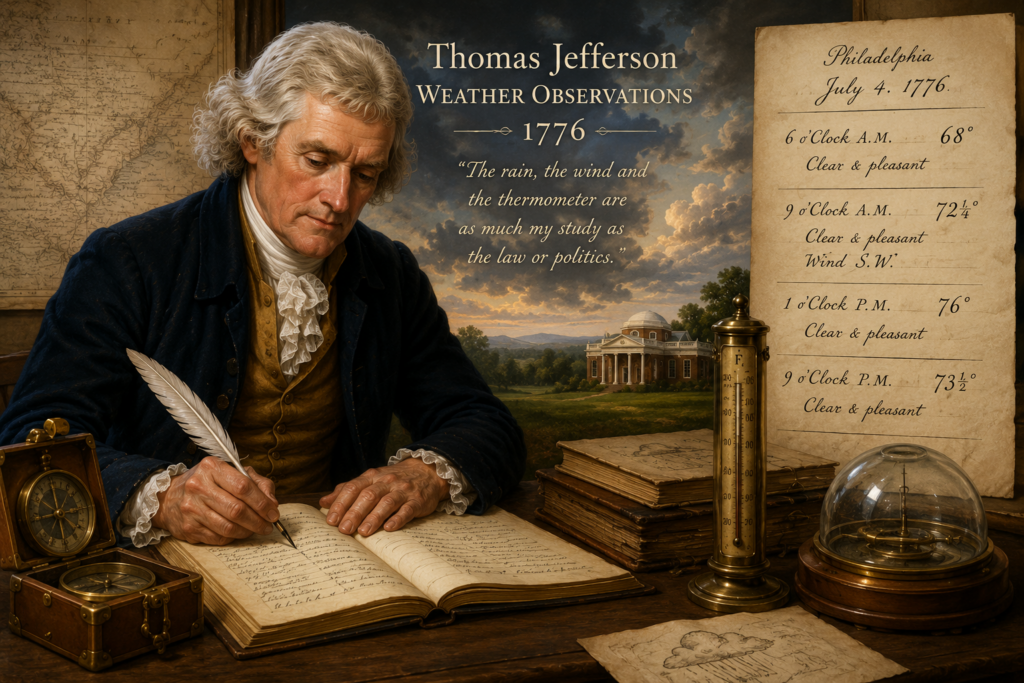
While history was being written…
Picture Philadelphia on July 4, 1776.
Inside Independence Hall, the Continental Congress was approving the Declaration of Independence and forever changing the course of history. Outside, summer sunshine warmed the city.
And one of those Founding Fathers kept doing something wonderfully unexpected.
He checked the weather.
Meet America’s original weather observer
Thomas Jefferson is remembered as a President, an inventor, and the principal author of the Declaration of Independence.
He was also one of America’s earliest and most dedicated weather observers.
Long before Doppler radar, satellites, weather balloons, or smartphone apps, Jefferson faithfully carried thermometers and recorded weather observations almost every day. Over more than fifty years, he collected nearly 19,000 weather observations from almost 100 different locations, creating one of the earliest and most remarkable weather records in American history.
If the Climate Adaptation Center had existed in 1776…
We have a feeling Jefferson would have fit right in.
What was the weather like on America’s first Independence Day?
Here’s one of our favorite Fourth of July facts.
Thanks to the Thomas Jefferson weather journal, we know exactly what the weather was like as America declared its independence.
At 6:00 that morning, the temperature was 68 degrees.
By 9:00 a.m., it had warmed to 72¼ degrees.
At 1:00 p.m., it reached a comfortable 76 degrees.
By 9:00 that evening, it was still a pleasant 73½ degrees.
Honestly?
That sounds like the kind of Fourth of July forecast every community hopes for before the fireworks begin.
Weather tells us about today. Climate tells us about decades.
People often hear the words weather and climate used together, but they mean different things.
Weather is what happens today or this week. Climate is the pattern that emerges after observing weather for many years. Think of weather as one page in a diary. Climate is the story you discover after reading every page for decades.
Jefferson didn’t know it at the time, but every observation he recorded became another page in that story.
Small observations became a big legacy
Jefferson wasn’t trying to prove a theory.
He was simply curious.
Day after day, year after year, he carefully wrote down what he saw. Those handwritten observations eventually became part of the historical record that scientists can compare with modern weather observations to better understand how our atmosphere has changed over the past 250 years.
It’s a reminder that science often begins with something simple.
Paying attention.
From Jefferson’s journal to Florida’s future
Jefferson never visited today’s Florida Gulf Coast, but his curiosity certainly lives here.
Every day, weather stations across Florida quietly do what Jefferson once did by hand. They measure temperature, rainfall, humidity, wind, and dozens of other conditions. Over time, those observations become an invaluable record that helps scientists better understand Florida’s changing climate and helps communities prepare for challenges such as extreme heat, heavy rainfall, hurricanes, and coastal flooding.
A legacy woven into our work
Thomas Jefferson couldn’t have imagined satellites orbiting Earth, supercomputers analyzing weather data, or artificial intelligence helping scientists recognize patterns across millions of observations.
But he understood something timeless.
The best decisions begin with good observations.
That same philosophy is woven into the work we do every day at the Climate Adaptation Center. By combining today’s advanced technology with decades of weather records and centuries of observations, including the kind of careful record-keeping Jefferson began, we help communities better understand their changing climate and prepare for the future.
In many ways, every climate assessment, resilience recommendation, and research project builds on the same simple idea that inspired Jefferson nearly 250 years ago.
Pay attention to the sky. Learn from it. Prepare for what’s next.
Continuing the tradition
Thomas Jefferson believed that understanding tomorrow begins with carefully observing today. At the Climate Adaptation Center, that same philosophy guides our work every day. We continuously monitor our changing climate, study weather patterns, and communicate what they mean for our communities so families, businesses, and local leaders can make informed decisions.
Here in Florida, no weather threat demands more attention than hurricanes. Our team closely tracks every tropical system from its earliest stages, providing clear, science-based updates focused on what matters most for the Suncoast. If you’d like to stay ahead of the next storm, click “Get Hurricane Updates” at the top of this story to receive our free hurricane updates throughout the season.