At the 6th Annual CAC Florida Climate Conference, the Climate Adaptation Center will unveil the framework for an ambitious effort to make Sarasota a model for understanding climate change and building coastal resilience.
What if Sarasota Bay itself could become one enormous climate laboratory?
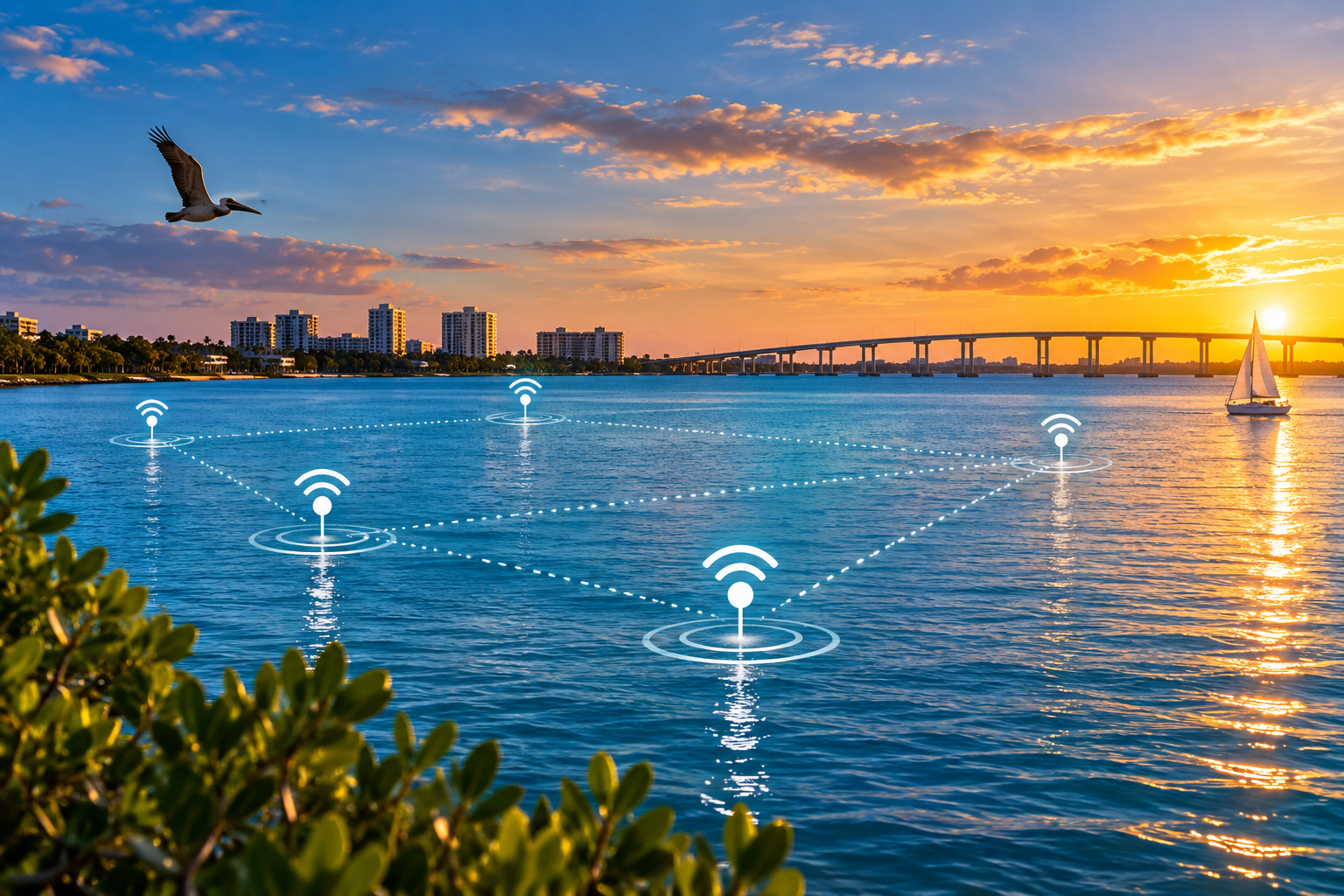
Not a laboratory behind walls, but a living one stretching across our coastal environment, bringing together environmental observations, forecasting, artificial intelligence and, eventually, a digital twin to help us better understand what is happening around us and what may come next.
Imagine having increasingly detailed information about our atmosphere, water and coastal environment, helping scientists better understand changes as they happen and giving community leaders better information as they make decisions about Sarasota’s future.
That is the vision behind the Sarasota Living Laboratory for Coastal Resilience.
Sarasota Bay could become the laboratory. Sarasota could become the prototype.
And at the 6th Annual CAC Florida Climate Conference on November 12, Climate Adaptation Center CEO Bob Bunting will unveil the framework for this ambitious effort and show how Sarasota’s scientific, environmental, cultural and civic assets could ultimately become part of an integrated coastal resilience system.
Why We Need a Living Laboratory
Florida is on the front lines of a changing climate.
Our atmosphere and oceans are warming. Sea level is rising. Coastal communities must contend with flooding, extreme weather, water-quality challenges and other environmental changes that can affect everything from infrastructure and ecosystems to our economy and quality of life.
But there is a fundamental challenge:
We cannot adequately understand what we do not adequately observe.
Florida has important gaps in the observations needed to understand how our coastal environment is changing at the local level. Bunting describes it as “flying with one eye shut.”
We have tremendous scientific capabilities and enormous amounts of information. But imagine what becomes possible when observations across a coastal region can increasingly be brought together, analyzed and connected with advanced forecasting and modeling.
That is where the Living Laboratory comes in.
What Could the Living Laboratory Become?
The idea is both ambitious and straightforward: use Sarasota Bay and the surrounding coastal region as a real-world laboratory.
The Living Laboratory is envisioned as an interconnected system combining environmental sensors and scientific observations with forecasting, artificial intelligence and, eventually, a digital twin of the region.
Instead of simply collecting individual pieces of information, the goal is to develop a much more comprehensive understanding of what is happening across our coastal environment.
What is changing? How quickly is it changing? What might happen next? And how can better information help us make better decisions?
Over time, this kind of integrated coastal intelligence system could help scientists, institutions and community leaders better understand changing conditions and evaluate strategies for resilience.
The ultimate objective isn’t simply more data.
It’s better decisions.
Why Sarasota?
There is a reason Sarasota is uniquely positioned for an effort like this.
Look around Sarasota Bay and you’ll find an extraordinary concentration of scientific, educational, environmental, cultural and civic assets.
Marie Selby Botanical Gardens. The Bay Park. New College of Florida. The Ringling Museum. Sarasota Orchestra.
These are some of Sarasota’s crown jewels.
And each represents something different that can contribute to our understanding of resilience.
Marie Selby Botanical Gardens and The Bay are envisioned as initial Living Laboratory sites. Selby offers a real-world setting where environmental observations, resilience strategies and technology can be explored together. The Bay offers another kind of laboratory, with features including stormwater treatment, elevated areas and a living shoreline.
The opportunity is to begin connecting assets like these into something larger.
Climate resilience cannot exist in silos. Science, technology, education, cultural institutions, businesses, government and the broader community all have roles to play.
The Living Laboratory provides a framework for bringing those capabilities together.
November 12 Is an Important Next Step
This year’s 6th Annual CAC Florida Climate Conference: From Climate Risk to Climate Resilience is about more than discussing the challenges ahead.
It’s about exploring what we can do about them.
The conference represents an important next step: bringing the vision, science, technology and potential partners together around a framework for what the Living Laboratory could become.
Bunting will present the framework for the Sarasota Living Laboratory for Coastal Resilience, including how observations, modeling and decision support could ultimately work together as an integrated system.
But the Living Laboratory is only part of an extraordinary day of science, ideas and conversation.
Leading Climate Experts Are Coming to Sarasota
Benjamin Kirtman, Ph.D., Dean and Professor of Atmospheric Sciences at the University of Miami Rosenstiel School of Marine, Atmospheric, and Earth Science and Director of NOAA’s Cooperative Institute for Marine and Atmospheric Studies, will deliver the keynote address.
Kirtman will examine the state of climate prediction and what today’s models are telling us about evolving risk in a changing climate, including coastal impacts and extreme events.
David Tomasko, Ph.D., Watershed & Water Quality Director at Environmental Science Associates and former Director of the Sarasota Bay Estuary Program, will explore another critical piece of our coastal future: how climate change may affect our ability to manage coastal water quality.
The conference will also feature leaders representing some of Sarasota’s most important institutions, including Jennifer Rominiecki, President and CEO of Marie Selby Botanical Gardens; A.G. Lafley, Founding CEO of The Bay Park Conservancy; and Joe McKenna, President and CEO of Sarasota Orchestra.
Throughout the day, scientists and community leaders will explore how climate science, observational systems, technology, cultural institutions and civic leadership can begin working together rather than independently.
From an Idea to Action
This is an ambitious vision, and November 12 isn’t the finish line.
It’s an opportunity to show what is possible.
The Living Laboratory framework offers a path toward connecting Sarasota’s remarkable assets around a common goal: understanding our changing coastal environment and using that knowledge to become more resilient.
And if that approach can be successfully demonstrated here, what Sarasota learns could ultimately extend far beyond the region.
The vision is for Sarasota Bay to become the laboratory and Sarasota to become the prototype, with lessons that could ultimately be shared with coastal communities across Florida, the nation and the world.
The ambition is to make resilience more than something Sarasota discusses.
It can become something Sarasota observes, tests, demonstrates and shares.
Be There When We Unveil the Framework
If you care about Sarasota, Florida’s Gulf Coast or how coastal communities can prepare intelligently for a changing climate, this is a conference you don’t want to miss.
Come see the framework. Hear from the scientists. Meet the community leaders. Ask questions. And see what the next chapter of coastal resilience in Sarasota could look like.
The 6th Annual CAC Florida Climate Conference takes place Thursday, November 12, 2026, from 9 a.m. to 4 p.m. at Selby Auditorium, New College of Florida North Campus, formerly the University of South Florida Sarasota-Manatee Campus.
This is about moving from climate risk to climate resilience.
On November 12, we’ll show you what that future could look like.