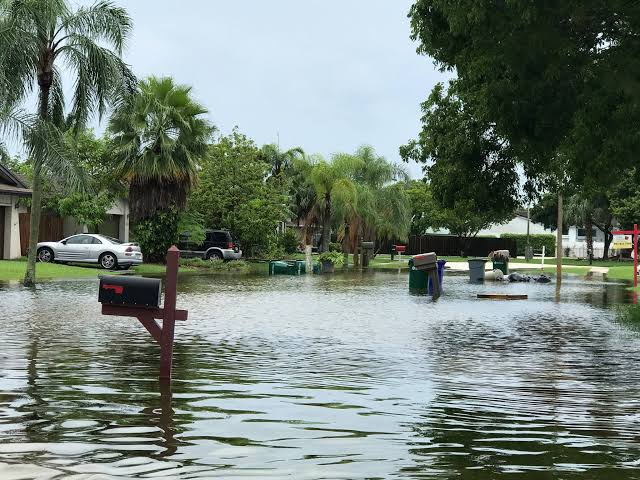
America just had at least its third 1000-year rainfall event in three days.
Let that sit for a second. Palm Beach Gardens took 17 inches of rain in 6 hours, one mapped total 17.36 inches.
The 1000-year mark for a 6-hour total there is 9 inches, so this was not a close call, it was nearly double.
That same weekend, Crossroads, Mississippi took radar-estimated totals near 19 inches in about six hours on Halloween night, with a flash flood emergency covering roughly a thousand people. And the pattern is wider than three days.
In late October, parts of Colorado’s San Luis Valley recorded two-day totals above the 1000-year mark, including 4.46 inches at South Fork.
Here is why this is happening, and why it is different from just saying these are rare. A 1000-year event does not mean once every thousand years. It means a 1-in-1000 chance, 0.1 percent, in any given year at any one spot, based on our historical climate. That is the climate of the past talking. For every degree centigrade the climate warms, the atmosphere can hold 7 percent more water. Add to that the extreme ocean temperatures of this El Niño, and you set off the kind of El Niño induced, climate induced events we are now seeing, events that are becoming increasingly common.
We have been writing about this Super El Niño, and about what it would do to our weather. Now it is coming home to roost. The climate of the past could only generate these once in a thousand years. The climate we live in now generates them again and again.
When the old 9-inch line gets beaten by nearly double, and when Sarasota itself had a 1000-year hour in June 2024, 3.93 inches in one hour at our airport, statistics built on data that looks backward 100 years, weighted equally for each year, are not describing our weather anymore. The baseline moved.
That same Sunday, as those storms pounded Palm Beach County, a Learjet went down there, nine lives lost. The crash occurred during this extreme weather event. That is why we have to be more prepared than we were 50 years ago. Fifty years ago we built to statistics drawn from the past. And we know that to be climate resilient, we can’t look in the rearview mirror. We should not be using data that looks backward 100 years and is weighted equally for each year.
The climate is changing faster than our statistical methods of the past. That can be fixed, too. That is why the Living Laboratory for Coastal Resilience is going to focus on the here and now, and on what is likely to come, Sarasota ground truth, continuous data along our shoreline, and models that learn from what is actually happening, built into a prototype other coastal communities can use.
We unveil that framework November 12 at Selby Auditorium, New College of Florida North Campus, Sarasota. Join us in person or online. In-person and virtual tickets: https://tinyurl.com/2aplfprg