
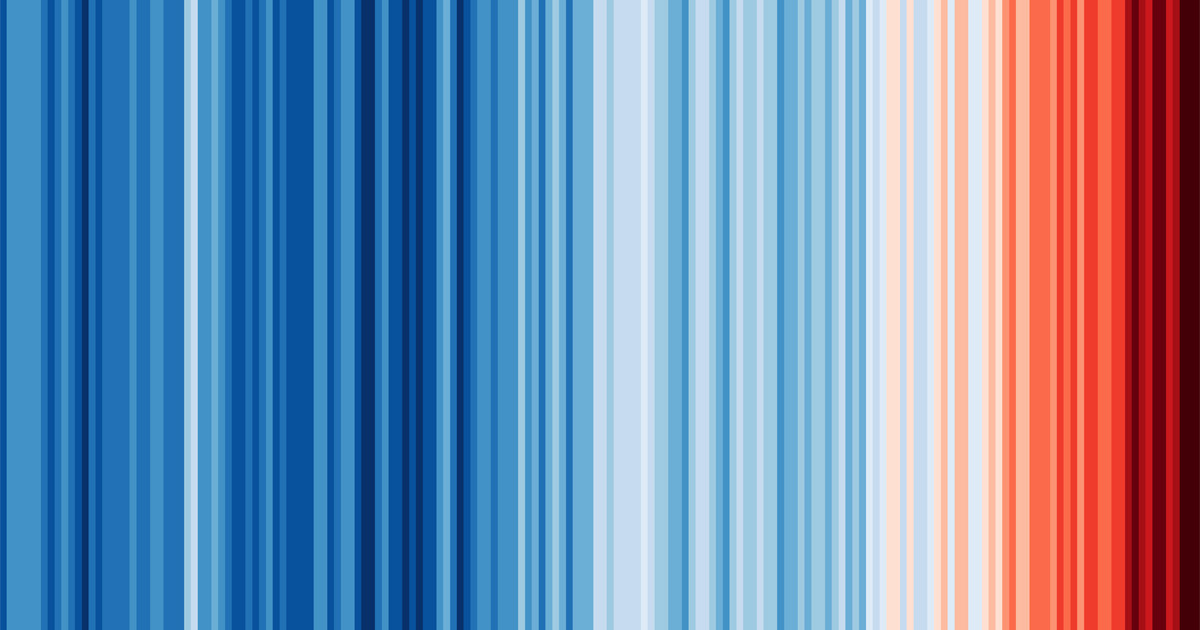
2025 Climate Stripes – Ed Hawkins, University of Exeter
The Heat Continues…
The global data are in, the numbers have been crunched and, you guessed it, the year 2025 was a hot one. In fact, at 1.47°C above the pre-industrial level, 2025 was the third warmest year since 1850, surpassed only by 2023 and 2024.
Analysis by Europe’s Copernicus Climate Change Service (C3S) shows that the global average surface air temperature in 2025 was just 0.01°C cooler than 2023’s 1.48°C. 2024 remains the hottest year on record, at 1.60°C above the pre-industrial average. This unprecedented warmth is not a flash in the pan. The last 11 years have been the warmest in the global record.
C3S found that the 2025 average air temperature over global land areas was the second warmest on record. The Antarctic saw its hottest year on record, while the Arctic recorded its 2nd warmest year.
The last three years (2023-2025) set another (unwanted) record—the first time a three-year average exceeded the 1.5°C warming limit set by the 2015 Paris Agreement.
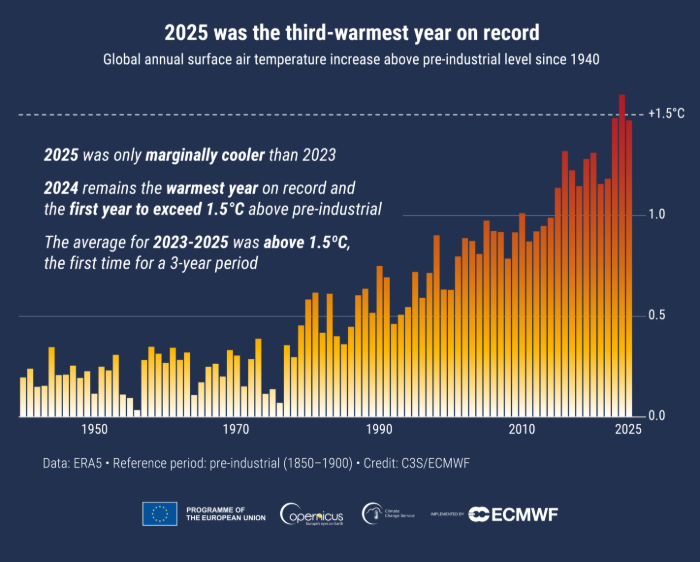
2025 Highlights:
- Every month except February and December was warmer than that month in any year before 2023 (ECMWF)
- 9.1% of Earth’s surface experienced a locally record warm annual average in 2025 (10.6% of land areas; 8.3% of ocean areas) (Berkeley Earth)
- No region on Earth recorded a locally record cold annual average in 2025 (Berkeley Earth)
- Antarctica recorded its warmest year on record, while the Arctic experienced its second warmest (ECMWF)
- Roughly 770 million people (8.5% of the global population) experienced locally record-warm annual conditions (Berkeley Earth)
- Record high annual temperatures were noted in several regions, including the northwestern and southwestern Pacific, the northeastern Atlantic, central Asia, and in far eastern and northwestern Europe (Berkeley Earth)
As we know, global warming is driven primarily by steadily increasing levels of greenhouse gases in the atmosphere, predominantly CO2. In fact, atmospheric CO2 reached record levels in 2025, as shown in the following graph.
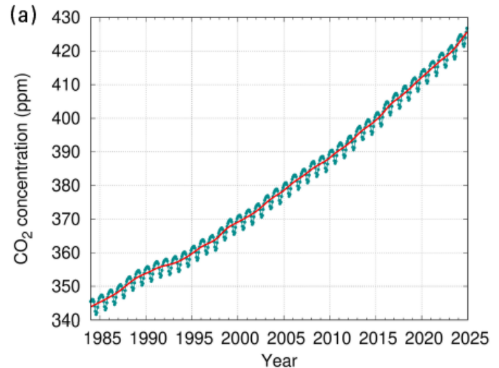
Credit: World Meteorological Organization (WMO) Greenhouse Gas Bulletin No.21
While steadily increasing, the upward trajectory of global average temperature is far more irregular than the annual increase in atmospheric CO2 would suggest. In reality, climate warming reflects a combination of warming driven by greenhouse gases, natural variability in the earth’s climate, and additional short-term events (major volcanic eruptions, for example). Outside of greenhouse gases, natural climate variability, notably the El Niño Southern Oscillation (ENSO) in the Pacific Ocean region, has perhaps the greatest impact on global annual temperatures.
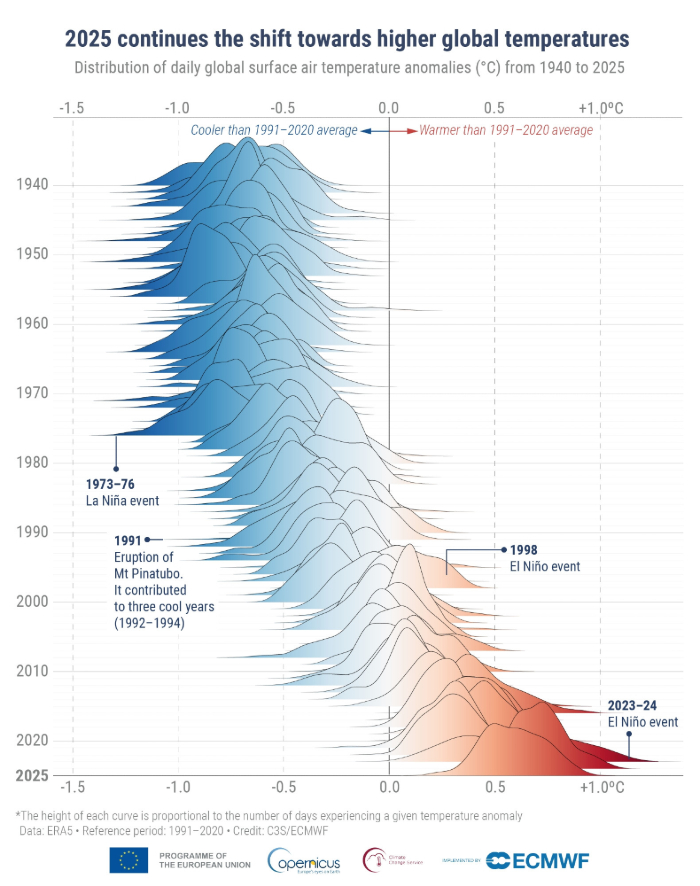
The following figure combines daily global average temperatures since 1940 in a “ridge diagram” annotated with key events. (Note that the diagram’s temperature scale is relative to the 1991-2020 average—the current 30 year meteorological average.) As we can see, the dramatic warming in the last few years coincides with warm surface waters in the Pacific Ocean, the result of a strong El Niño event in 2023-2024. Similarly, the weak La Niña event in 2025 had a mild cooling effect.
In the long-term graph below, we can see that global climate warming didn’t really evidence an upward trend until the 1920s. We can also see that climate warming kicked into high gear in the early 1970s and has continued at a rapid rate ever since.
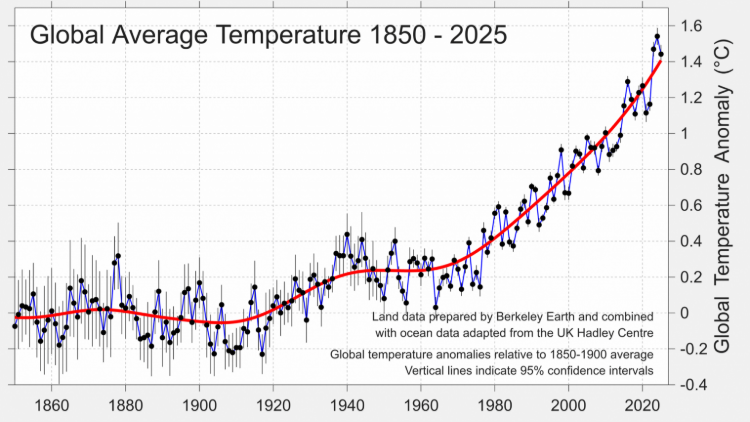
Credit: Berkeley Earth
Is Climate Warming Accelerating?
According to Berkeley Earth, global warming has proceeded at a roughly linear pace since 1970. That is to say that we can determine a straight line through the annual temperature data such that the deviations of the data from the trend line fall within a range that is statistically consistent with the overall trend. Until very recently, this was the case for annual global temperature data, as shown in the dark gray area of the graph below.
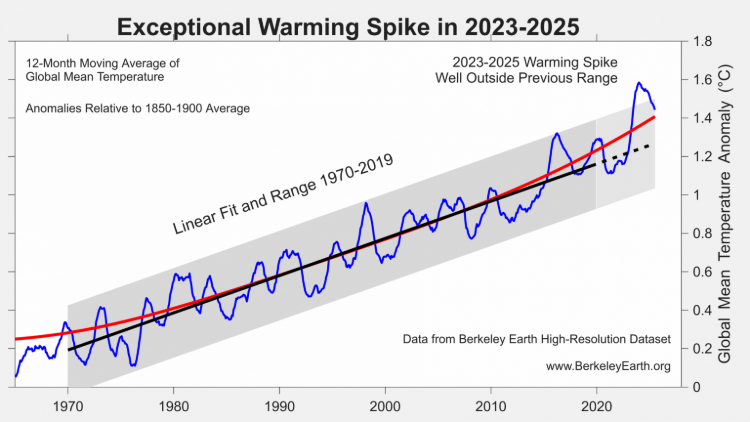
However, in the period from 2023 to 2025 a dramatic spike in the warming data falls well outside the boundaries of the long term trend. Berkeley Earth chief scientist Robert Rohde notes:
“If we were to assume that global warming was continuing at the same rate as during the 50-year period 1970-2019, then the 2023 to 2025 excursion would be by far the largest deviation from that trend, with less than a 1-in-100 chance of occurring solely due to natural variability.”
While 1-in-100 chance events happen once in a while, in this instance it’s more than likely that we are seeing an acceleration of climate warming.
What’s Ahead?
The cooling effect of the weak 2025 La Niña is likely to persist until warmer El Niño conditions develop in late 2026. So we can probably expect a 2026 global average temperature roughly 1.4°C above pre-industrial levels, followed by a warmer 2027.
Consensus estimates suggest that the global temperature multi-year average will blow through the Paris Agreement best-case limit of 1.5°C above pre-industrial levels by the end of the decade.