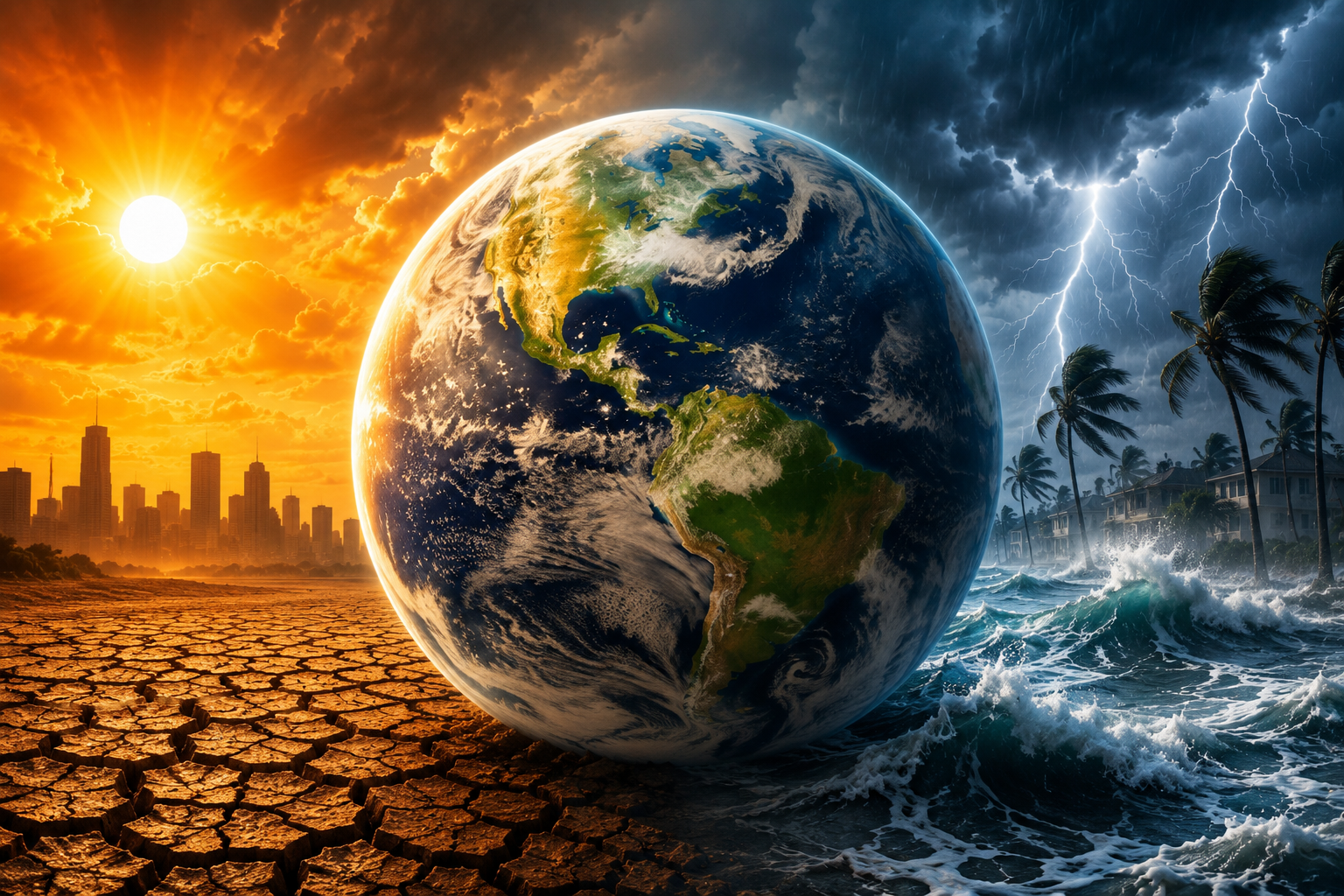
The climate future scientists warned about for decades is no longer something on the distant horizon. It is here.
This summer has provided another powerful reminder. Persistent heat domes have settled over both North America and Europe, producing prolonged periods of dangerous temperatures, placing stress on electrical grids, increasing wildfires, and affecting agriculture and human health. At the same time, the Pacific Ocean is showing strong signs of an emerging El Niño. Combined with record or near-record ocean temperatures around the world, it raises concerns about continued climate extremes in the months ahead.
The Science Has Never Been Stronger
Global temperatures, ocean heat content, sea level, and atmospheric greenhouse gas concentrations continue to reach historic levels. One of the most important developments in climate science is how much our ability to understand the Earth system has improved. I have had the privilege of watching that evolution firsthand.
Back in the 1980s, I served as a director of the corporation that operates the National Center for Atmospheric Research (NCAR) in Boulder, Colorado. It was an exciting time in atmospheric science. For the first time in history, scientists were able to run global climate models that coupled the atmosphere and the oceans together. These were the first attempts to simulate the entire climate system.
Those early models made a bold prediction. If humans continued increasing greenhouse gases, the planet would warm significantly. Like many scientists at the time, I was cautious. Models are powerful tools, but they must be tested. The question was whether these early climate models were truly capturing the behavior of the real world.
The Experiment That Built Confidence
A very clever experiment helped answer that question. Scientists ran the models forward in time but held atmospheric CO₂ constant instead of allowing it to increase each year from industrial emissions. The result? The predicted warming largely disappeared.
Then they ran the models again, this time including the actual increases in CO₂ from human activities. The warming signal appeared exactly as climate physics and thermodynamics predicted. That was a powerful demonstration that greenhouse gases were not simply correlated with warming. They were the cause of the warming signal in the models.
Those early models were primitive compared with today’s Earth System Models. They had lower resolution and lacked many of the complex processes we can now simulate, including improved representations of the carbon cycle, ice sheets, ecosystems, and ocean circulation. Yet they got the fundamental physics right. In fact, if those early models had been wrong, they would have predicted far fewer of the impacts we are now experiencing, including the increasing frequency of extreme heat events and persistent heat domes.
Today’s Models Continue to Improve
Today’s models are better than ever, but they still have uncertainties. Regional rainfall patterns, cloud feedbacks, tropical cyclone behavior, atmospheric blocking patterns, and major ocean circulation changes such as the Atlantic Meridional Overturning Circulation remain areas of active research.
Those uncertainties do not weaken the science. They simply remind us that adaptation requires continuous observation and learning.
Why Local Science Matters
The Climate Adaptation Center was founded on the belief that communities need more than global climate projections. They need local, actionable information that helps them make better decisions.
Since launching one of Florida’s first independent seasonal hurricane forecasts in 2018, CAC has worked to bring advanced climate science closer to the people of Florida’s Suncoast. We developed the first regional climate and weather forecast focused specifically on our region, helping communities better understand the risks ahead.
In 2021, CAC held the first Florida Climate Forecast Conference, creating a forum where scientists, community leaders, businesses, educators, and citizens could come together to discuss what the latest science means for Florida’s future.
Our guiding principle has remained simple.
Science should inform decisions, not politics.
We do not take government funding. Our work is supported by the public, private partners, and individuals who believe communities deserve independent, science-based information. That support is what fuels CAC and allows us to provide a clear, politically neutral view of climate risks, weather trends, and solutions.
One Environmental Success Story Offers Hope
My confidence in what science and society can accomplish comes from another major environmental success story, the recovery of the ozone layer.
I was fortunate to be involved in the effort surrounding one of the greatest environmental achievements in modern history. Scientists discovered that chlorofluorocarbons (CFCs) were damaging Earth’s protective ozone layer. Through scientific research, public awareness, and international cooperation under the Montreal Protocol, nations acted to reduce ozone-depleting chemicals.
The result is one of the best examples we have that humanity can solve global environmental problems when science, innovation, and cooperation come together. The ozone hole is now recovering.
That experience shaped my belief that climate warming should be approached with urgency, but also with confidence in human ingenuity.
The Next Chapter: Sarasota’s Living Laboratory
That philosophy is at the heart of CAC’s next major initiative, the Living Laboratory for Coastal Resilience (LLCR) in Sarasota.
The LLCR is designed to move beyond simply studying climate risks. It will create a real-world laboratory for coastal climate adaptation, integrating advanced environmental sensors, including weather, water and air quality sensors, artificial intelligence, high-resolution weather observations, and digital twin technology.
The goal is to better understand and address the challenges communities are facing now, including flooding, rising seas, urban heat islands, stormwater management, coastal resilience, and ecosystem health. By bringing together universities, cultural organizations, local leaders, scientists, and community partners, Sarasota can become a model for coastal communities around the world.
The Challenges and the Opportunity
The reality is that we need both mitigation and adaptation. Reducing greenhouse gas emissions remains essential, but communities must also prepare for changes that are already underway.
There are reasons for optimism. Renewable energy continues to expand. Battery storage is improving rapidly. Artificial intelligence is opening new possibilities for climate forecasting and environmental monitoring. Scientific collaboration is stronger than ever.
But the challenges are real. Heat waves are becoming more intense. Extreme rainfall events are increasing in many regions. Sea level rise will continue for decades because of past emissions already in the climate system. Recent heat domes have shown the human cost of these changes, with thousands of heat-related deaths reported during extreme events, including approximately 2,700 excess deaths attributed to a recent heat episode in France.
The Future Is Still Ours to Shape
Climate warming is neither a reason for complacency nor despair.
The lesson from the ozone recovery is that when people understand a problem and work together, progress is possible. The science tells us both that the risks are real and that our choices matter.
The future will be shaped by the decisions we make today: reducing emissions, investing in resilience, improving forecasting, and creating communities that can adapt and thrive.
The challenge is enormous.
But so is our ability to meet it.
Stay Ahead of Hurricane Season
Understanding climate trends is only the first step. Staying informed throughout hurricane season can help you make better decisions for your family, your home, and your community.
Sign up for the Climate Adaptation Center’s free Hurricane Updates newsletter to receive trusted forecasts, hurricane outlooks, important weather updates, and practical preparedness information throughout the season.
Click “Get Hurricane Updates” at the top of this page to subscribe.