You don’t have to live on the waterfront to worry about flooding. A new scientific initiative could change how Sarasota understands water, weather, and the risks facing our communities.
You live five miles inland. Maybe ten. Your neighborhood has sidewalks, retention ponds, and absolutely no ocean view.
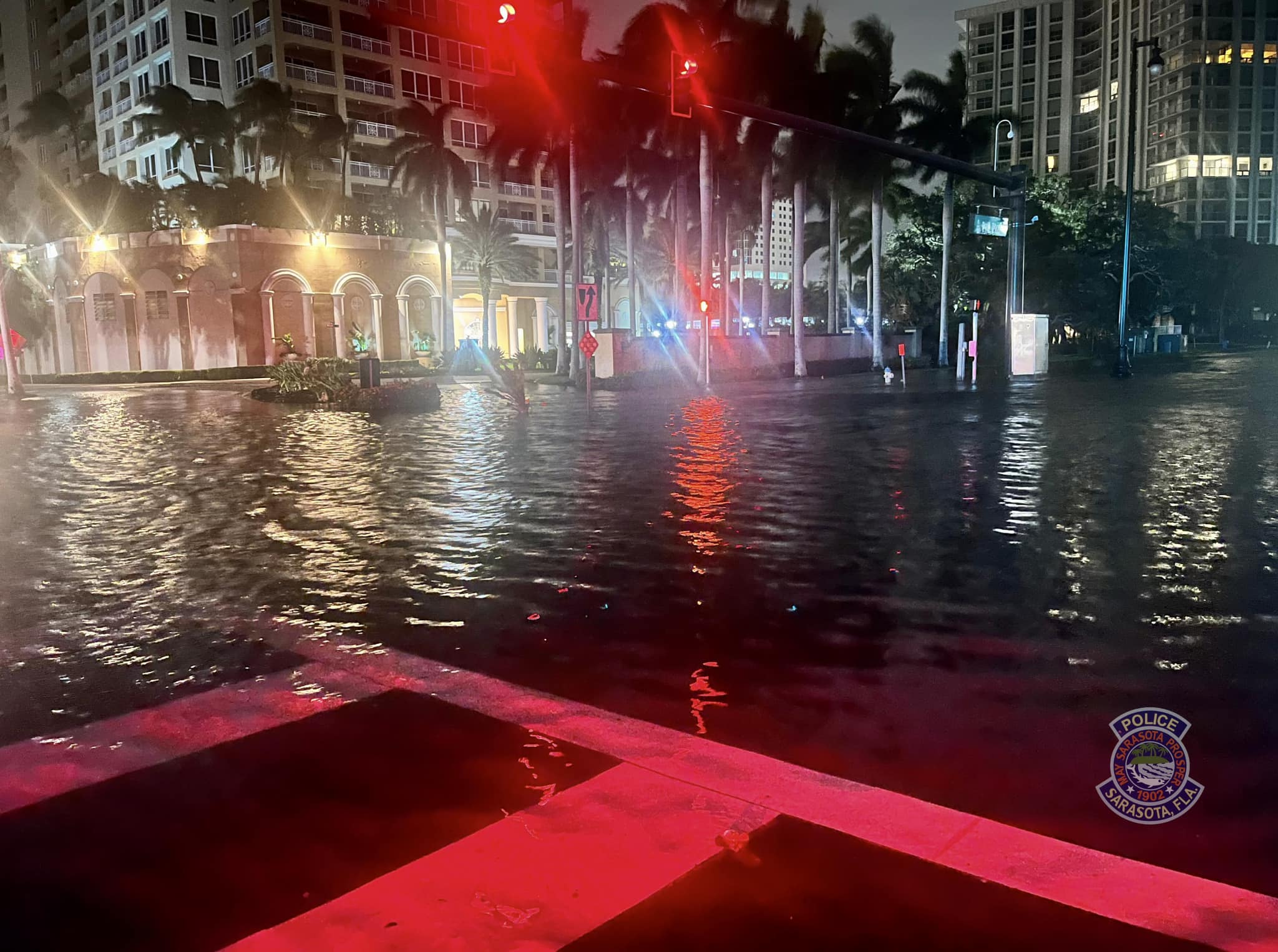
Then a Florida thunderstorm arrives.
Rain pours onto rooftops and streets. Water collects along the curbs, and the retention pond behind your house begins rising.
Suddenly, you’re wondering: Where is all this water going to go?
Now imagine scientists could better understand how water moves through our communities, where flooding might occur, and what improvements could help reduce the risks.
That’s part of the scientific challenge behind an ambitious project taking shape in Sarasota.
And it begins with a surprising problem.
Sarasota Bay has a measurement problem
Florida has some of the world’s most sophisticated weather forecasting capabilities. Satellites monitor storms, radar tracks rainfall, and computer models predict atmospheric conditions days into the future.
Yet important gaps remain in our understanding of local coastal conditions.
According to Bob Bunting, founder and CEO of the Climate Adaptation Center (CAC), Sarasota Bay lacks the continuous, long-term sea level observations needed to establish its own detailed record of change.
Scientists can estimate regional sea-level trends using nearby measurements, satellites, and models. But that’s not the same as maintaining a continuous record within Sarasota Bay itself. There’s a difference between estimating what’s happening and measuring it consistently over time.
For communities investing in roads, drainage systems, homes, and public infrastructure, that distinction matters.
Bunting believes Florida needs a more complete coastal observation system. His vision for Sarasota is designed to help close that gap. But why should someone living miles from the shoreline care?
You don’t need a waterfront home to have a water problem
During a Florida downpour, rainwater flows across rooftops, roads, parking lots, and lawns. Some soaks into the ground. The rest moves toward storm drains, ditches, canals, and retention ponds. But what happens when rainfall arrives faster than the drainage system can handle it? What if the ground is already saturated or retention ponds are nearly full?
In some coastal drainage systems, elevated tides can also slow the movement of stormwater toward its outlet, making flooding worse or causing water to remain longer.
Farther inland, flooding may depend much more on rainfall intensity, terrain, soil conditions, and drainage capacity. Not every flooded neighborhood is affected by sea-level rise. But the larger scientific challenge is similar.
To understand flooding, we need to understand how water moves through the entire system. That means connecting observations, understanding how different conditions interact, and using that knowledge to make better decisions.
And that’s where the Living Laboratory comes in.
What exactly is a Living Laboratory?
The Climate Adaptation Center is developing the Sarasota Living Laboratory for Coastal Resilience, or LLCR.
Think of it as a laboratory without walls. Instead of studying coastal conditions through disconnected measurements, the initiative envisions bringing together environmental sensors, scientific observations, forecasting, advanced technology, and community partnerships.
The goal is to develop a more complete picture of what’s happening in and around Sarasota Bay. Eventually, that information could help communities anticipate risks and evaluate possible solutions.
Bunting describes the need for a coastal intelligence system. It’s not simply about collecting more numbers. It’s about turning scientific observations into information that community leaders can use. Knowing that water levels are rising is important.
Understanding what those changes mean for homes, roads, businesses, and neighborhoods is where the science becomes especially valuable.
So could Sarasota actually see its next flood coming?
Potentially, yes. Scientists already use rainfall forecasts, water-level observations, and computer models to anticipate flooding. But predicting exactly which streets or neighborhoods will flood remains much more difficult.
The Living Laboratory’s vision is to help close that gap by bringing together better local observations, scientific models, and eventually advanced tools such as artificial intelligence and a digital twin.
That doesn’t mean we’ll someday know precisely how deep the water will get in every driveway. But better information could help communities identify vulnerable areas, evaluate flooding scenarios, and make more informed decisions before the next storm arrives.
The goal isn’t to predict every puddle. It’s to understand the risks before the water starts rising.
Could artificial intelligence help protect our coast?
Imagine sensors continuously collecting information about coastal conditions.
Now combine those observations with weather forecasts, historical records, and computer models. That’s an enormous amount of information.
Artificial intelligence could help scientists analyze those datasets, identify patterns, and investigate relationships that might otherwise be difficult to recognize. For example, researchers could explore how rainfall, tides, and other environmental conditions interact during storms. They could also examine how those relationships change over time and use what they learn to improve scientific models.
But AI isn’t magic. It can’t create reliable observations where none exist, eliminate uncertainty, or guarantee that a particular neighborhood will stay dry.
Before computers can help us understand what’s happening, we need reliable measurements of the real world.
And eventually, those measurements could support one of the most intriguing parts of the Living Laboratory vision.
A digital twin.
What if we could test solutions before building them?
Imagine a computer-based representation of Sarasota’s coastal environment, updated using observations and scientific models.
Scientists call this a digital twin. It could eventually allow researchers to explore how different conditions and proposed improvements might affect the coastline.
What happens during an unusually high tide combined with heavy rainfall? How might rising seas change future flooding risks? Could restoring a natural shoreline help reduce certain impacts? How might proposed infrastructure improvements perform under different conditions? Instead of relying solely on assumptions, researchers could simulate scenarios and compare possible outcomes.
Imagine exploring the consequences of a decision before spending millions of dollars putting it into practice.
That’s the potential.
A digital twin wouldn’t be a crystal ball. Its usefulness would depend on the quality of the observations, models, and scientific testing behind it. And it’s important to understand that the digital twin is a future part of the Living Laboratory’s vision, not an operational system already predicting neighborhood flooding.
Still, the possibilities are exciting. Better observations could improve scientific models. Better models could help communities make more informed decisions. And those decisions could shape how we prepare for the decades ahead.
Why Sarasota could become a model for other communities
Sarasota Bay is central to our region’s environment, economy, and quality of life. It’s also part of a coastal system facing multiple challenges, including hurricanes, storm surge, rising seas, extreme rainfall, and changing environmental conditions.
Meanwhile, communities must make investments that could last for generations. A road built today may still be in use decades from now. The same is true of drainage systems, public buildings, and waterfront developments. How do we make those decisions when the environment itself is changing? That’s the question at the heart of coastal resilience.
Sarasota already has organizations contributing different pieces to the conversation. Marie Selby Botanical Gardens, The Bay Park Conservancy, and Sarasota Orchestra’s planned Music Center reflect investments in the region’s environmental, cultural, and community future.
The Living Laboratory seeks to connect scientific understanding with the partnerships and decisions shaping that future. If successful, lessons learned here could help other coastal communities develop similar approaches.
Sarasota could become a place where coastal resilience isn’t just discussed. It’s studied, tested, and put into practice.
Knowing the risks is only the beginning
For years, much of the climate conversation has focused on identifying what could go wrong. How high might the seas rise? How intense could future rainfall become? What will changing conditions mean for coastal communities? Those questions remain essential. But identifying a problem is only the first step toward solving it.
What can we do about it? Which solutions are likely to work? And where should communities invest limited resources? That’s the transition the Climate Adaptation Center wants to encourage.
From climate risk to climate resilience.
The Living Laboratory represents an effort to connect scientific understanding with practical decisions about the future. The goal isn’t to build the world’s fanciest collection of coastal sensors. It’s to help protect the places where people live, work, and raise their families.
Whether that’s a waterfront condominium overlooking Sarasota Bay or a subdivision several miles inland. Because when the rain starts falling and the water begins rising, the question isn’t whether you have an ocean view.
It’s whether your community is prepared.
Be in the room on November 12
On Thursday, November 12, 2026, the Climate Adaptation Center will introduce the Sarasota Living Laboratory for Coastal Resilience at its 6th Annual Florida Climate Conference: From Climate Risk to Climate Resilience.
The conference brings together leading scientists, technology experts, business leaders, and community organizations to explore how better observations, advanced modeling, and partnerships can help Florida communities prepare for changing conditions.
Speakers include Dr. Benjamin Kirtman of the University of Miami, Bob Bunting, and other experts working to connect climate science with practical adaptation.
Attendees will learn about the Living Laboratory vision and how Sarasota could help develop a model for coastal resilience that other communities may eventually follow.
The future of our coast starts with better information, smarter decisions, and people willing to work together.
Join us for the 6th Annual Florida Climate Conference
Thursday, November 12, 2026 | 9 a.m. to 4 p.m.
Selby Auditorium
New College of Florida North Campus
(formerly USF Sarasota-Manatee Campus)
Sarasota, Florida
🎟️ Fewer than 50 in-person tickets remain! Get your tickets here.