
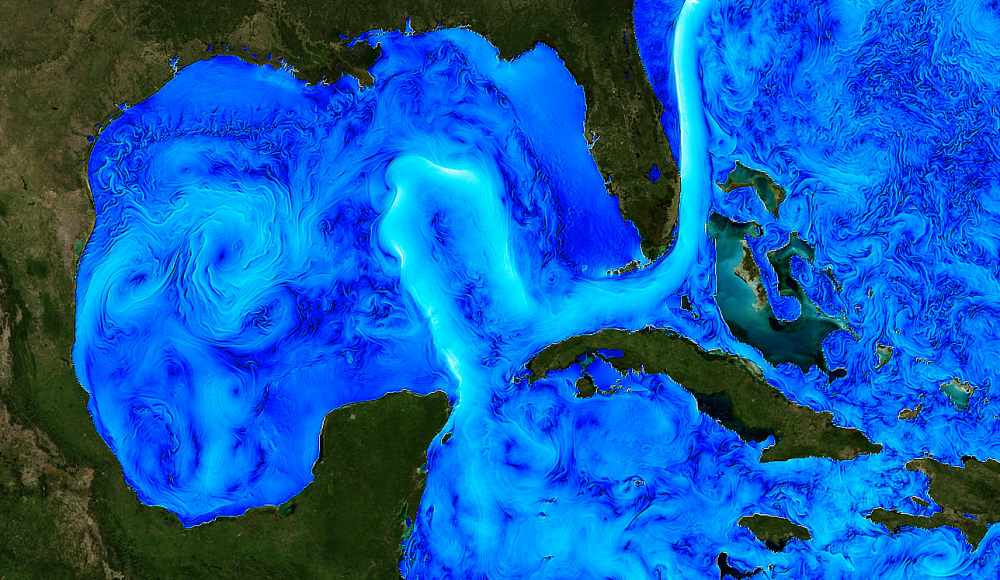
Image Credit: Gulf Coastal Ocean Observing System
And This Affects Florida
The warming Gulf of Mexico is changing one of the world’s most remarkable ocean currents. In this post, the Climate Adaptation Center’s CEO, Bob Bunting, explains why this matters to Florida.
For most of my career as a climate scientist, hurricane and severe weather forecasting focused primarily on the atmosphere. We tracked pressure, winds, moisture and sea surface temperatures because those were the best tools available. Today, one of the biggest advances in hurricane science is recognizing that what lies beneath the surface of the Gulf of Mexico can be just as important as what happens in the sky.
That brings us to one of the most fascinating ocean currents on Earth—the Loop Current.
It is a giant river of warm tropical water that enters the Gulf of Mexico through the Yucatán Channel, loops northward into the Gulf, and exits through the Florida Straits to become the Gulf Stream. It has existed for thousands of years, but the Gulf around it is changing. Understanding that distinction may be one of the most important keys to understanding the future of hurricanes along Florida’s Gulf Coast.
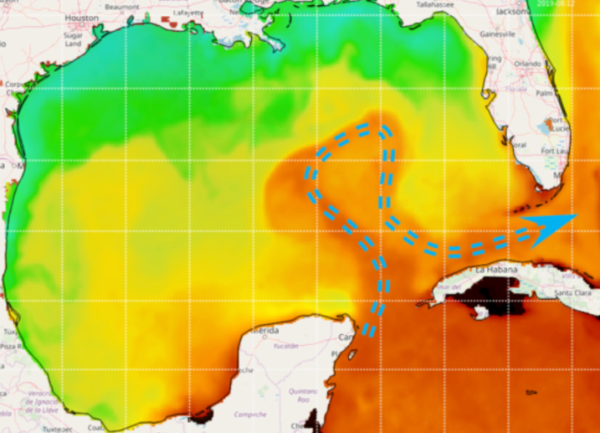
Figure 1: The Loop Current is clearly visible in this sea surface temperature satellite image. Credit: NOAA/AOML Ocean Viewer
One of the first questions people ask is whether climate change has made the Loop Current stronger. Based on the best available science, the answer is probably not. The current is largely controlled by the geometry of the Gulf and the pressure differences between the Caribbean Sea and the Atlantic Ocean. Its northward reach naturally varies, and it periodically sheds enormous warm-water eddies. That natural variability has always been part of the system.
What has changed is the Gulf itself. The evidence increasingly shows that the Loop Current has become a warmer conveyor belt—not necessarily a faster one. The Gulf is warming at about double the rate of oceans around our planet. (For more information on ocean warming, see our 2025 article.)
Over the past fifty years, the Gulf of Mexico has warmed substantially. More importantly, the warm layer now extends much deeper below the surface. Oceanographers call this Ocean Heat Content, and it is far more important to hurricanes than sea surface temperature alone. In places, exceptionally warm water—sometimes exceeding 86°F (30°C)—now extends hundreds of feet below the surface, creating an enormous reservoir of stored energy.
Think of it as the difference between a shallow puddle warmed by the sun and a deep lake that stores heat for months. Both may have the same surface temperature, but the deep lake contains far more energy. That deep reservoir is what hurricanes tap into. When the warm layer extends farther downward, a storm cannot churn enough cold water upward to weaken itself. Instead, it continues drawing energy from below, making rapid intensification much more likely.
The Gulf’s geography is central to this story. Surrounded by land and connected to the Caribbean and Atlantic by only two narrow passages, it behaves almost like a giant bathtub connected by two pipes. That confinement forces the Loop Current into its characteristic northward bend and causes it to periodically pinch off enormous warm-core eddies, some more than 200 miles across. These rotating pools of warm water slowly drift westward across the Gulf, transporting tremendous amounts of heat.
When hurricanes cross ordinary warm water, their powerful winds stir colder water upward, reducing their fuel supply. But when they pass over the Loop Current or one of these warm-core eddies, there may be little cool water available to reach the surface. Instead, the storm continues drawing energy from warm water extending hundreds of feet below. If atmospheric conditions are also favorable, explosive strengthening can occur.
Since 2017, the Gulf of Mexico region has been affected by an extraordinary number of Category 4 and 5 hurricanes. Katrina, Rita, Ida, Ian, Helene and Milton, among others as show by the graphic below, demonstrated the critical role deep ocean heat can play in hurricane intensity. Helene also illustrated another emerging reality. Even while remaining offshore for much of Florida’s west coast, it produced devastating storm surge and coastal flooding. The message is clear: hurricanes no longer must make a direct landfall to produce catastrophic consequences.
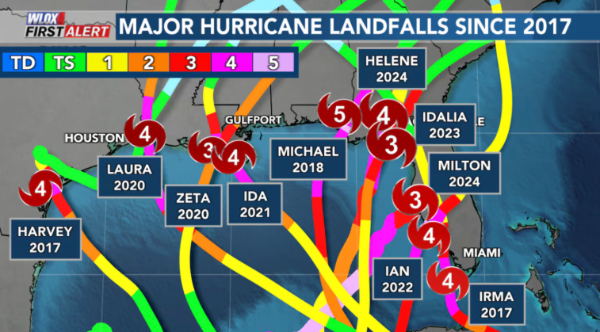
Figure 2: Since 2017, ten major hurricanes made landfall on the U.S. Gulf Coast. Between October 2005 and August 2017, there were no major hurricane landfalls in the U.S. Credit: WLOX
Sea level is also part of this story. Most discussions focus on melting glaciers, but warming seawater expands as it heats. Oceanographers call this steric sea-level rise. The Loop Current itself can temporarily raise sea level by several inches along portions of Florida through normal ocean dynamics. Add long-term global sea-level rise to that temporary increase, and storm surge begins from an already elevated baseline. Along Florida’s Gulf Coast, the observed rate of sea-level rise has increased dramatically over the past half century, further amplifying coastal flood risk.
Freshwater is playing a role as well. Major river systems—including the Mississippi, Atchafalaya, Mobile, Apalachicola and Peace Rivers—along with increasingly intense rainfall and hurricanes themselves, deliver enormous amounts of freshwater into the Gulf. Because freshwater is lighter than saltwater, it forms a less dense surface layer that suppresses vertical mixing. This stronger stratification helps retain heat near the surface while preserving the deeper warm reservoir below. Recent research also suggests the Loop Current can redistribute some of this freshwater throughout the Gulf and into the Florida Straits, adding another layer of complexity to an already remarkable system.
The Loop Current is more than a highway for heat. It is also a biological highway, transporting nutrients, fish larvae and marine organisms throughout the Gulf and beyond. Changes in temperature and stratification influence coral reefs, fisheries and, under extreme runoff conditions, harmful algal blooms. Scientists are only beginning to understand these interconnected effects.
It is equally important to remember that the Loop Current has always been a dynamic natural system. Its northward penetration changes. The timing of eddy shedding varies. El Niño, the Atlantic Ocean and other natural climate cycles all influence its behavior. Climate change is acting on top of this natural variability—not replacing it. Separating long-term trends from nature’s normal fluctuations is essential to good science.
The encouraging news is that our ability to monitor the Loop Current has never been better. Satellites, underwater gliders, Argo profiling floats, sea-surface height measurements, salinity observations and increasingly sophisticated artificial intelligence are giving scientists an unprecedented view of what is happening beneath the surface. These advances are improving hurricane forecasts and moving us toward digital twins of the Gulf that will simulate future conditions with remarkable accuracy. At the Climate Adaptation Center, we believe these tools should become part of routine decision-making for communities, businesses and emergency managers throughout Florida.
The atmosphere still determines where a hurricane goes. Increasingly, however, the Gulf helps determine what that hurricane can become.
The Loop Current has flowed through the Gulf for thousands of years, quietly transporting tropical heat toward Florida. Today, the Gulf around it is warmer, the heat reservoir is deeper, and the consequences are becoming increasingly evident. Understanding this hidden engine is no longer simply an oceanographic curiosity. It is essential to improving hurricane forecasts, strengthening coastal resilience and protecting the people, communities and economy of Florida’s Gulf Coast.