Title image: NOAA GOES West
Climate Change in Real Time
[Ed. note: This post was written on April 1, 2026 (hold the April fools jokes!). We attempt to describe the extraordinary U.S. weather events of March, 2026, and to predict some of their impacts in the months to come. This really is “climate change in real time.”]
Unexpected Heat
In March 2026, we experienced one of the most astonishing weather events in U.S. history. Over 11 days, a powerful heat wave, driven by an exceptionally large, slow-moving heat dome, formed over the southwestern U.S. before slowly moving eastward. In a month that normally marks the cool tail end of winter, the heat wave set over 7,000 daily high-temperature records and nearly 2,000 monthly records across the U.S. Over 160 cities experienced their hottest March on record, with 17 states setting new statewide March high-temperature records. [Ed. note: These are preliminary results. The definitive NOAA monthly national climate report for March will be published later in April]
Cities setting March records include Dallas, San Antonio, Oklahoma City, Albuquerque, Denver, Salt Lake City, Phoenix, Las Vegas, Los Angeles and San Francisco. Flagstaff, Arizona, tied or set their March record 10 days in a row. Many more cities experienced their second or third warmest March.
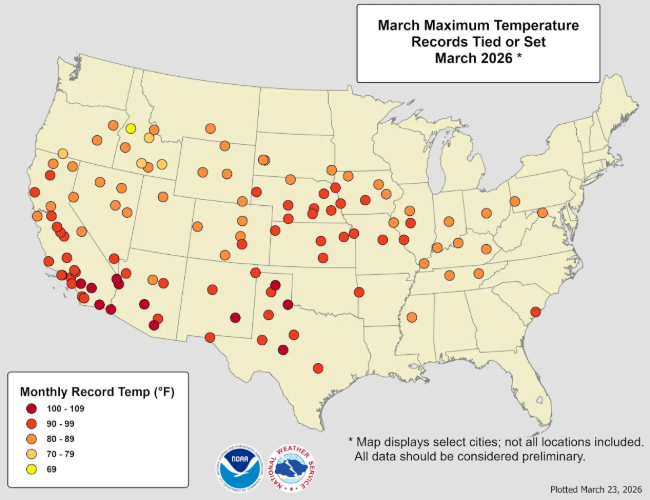
Figure 1: Representative Temperature Records in March 2026
The 2026 heat wave absolutely crushed the previous U.S. daily high temperature record for March of 108°F, setting a new record of 112°F. In NOAA’s final analysis, 2026 may well end up with the warmest month of March on record. The map below shows that is certainly the case for the Southwest in 2026!
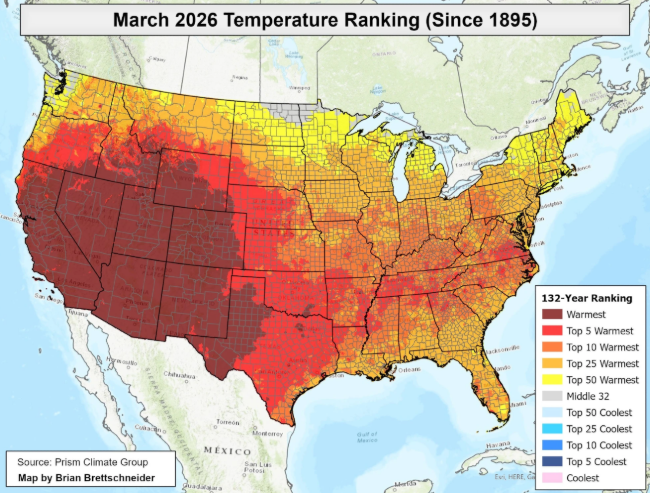
Figure 2: Potentially the hottest March in the 132 year record Credit: PRISM/University of Oregon
Daniel Swain, in an article for Weather West, sums it up: “… there has never been, in all of recorded history, a Southwestern U.S. heat event that yielded departures from typical seasonal temperatures as large as what were observed during the March 2026 event.” The graphic below shows the temperature anomaly to which Swain refers.
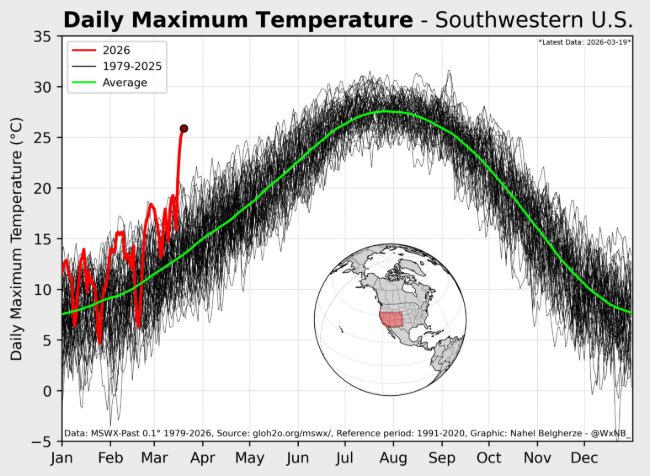
Figure 3: March 2026 is truly “off the charts”
But what led to a heat wave event of such magnitude, and more importantly, what are the future impacts?
Heat Domes and the Jet Stream
A heat dome develops when a slow-moving high pressure system traps heat near the Earth’s surface. The high-pressure system forces air downward; as that air compresses, it heats up. The system’s stable atmospheric column suppresses cloud formation and precipitation, the clear skies allowing solar radiation to further heat the surface. (Our earlier articles go into more detail here and here.)
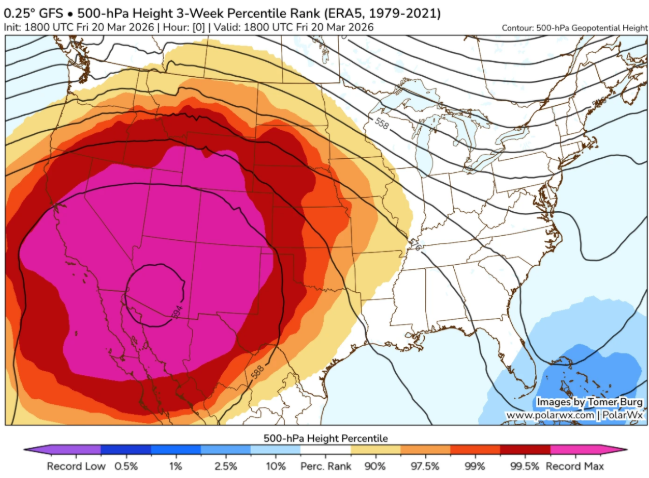
Figure 4: The March 2026 heat dome spans the entire Southwest
The Role of a Disrupted Jet Stream
Climate change is altering the behavior of the polar jet stream in ways that make heat domes more persistent. As Arctic temperatures warm faster than the mid-latitudes (a phenomenon called Arctic amplification), the north-south temperature gradient that drives the jet stream weakens, allowing it to meander into larger, slower “waves” that stall more frequently.
When the jet stream buckles and slows, it can lock high-pressure systems in place for days or weeks. This is exactly the dynamic that produced the March 2026 event: a slow-moving, exceptionally strong ridge parked over the Southwest, driving temperatures to summer-like levels in mid-March.
The strength and persistence of the March heat dome in the Southwest was likely due in part to severe weather 2,500 miles away, in Hawaii. Back-to-back intense “Kona low” subtropical cyclones hit Hawaii in March, dumping over two trillion gallons of water on the islands and fueling an atmospheric river riding the jet stream toward the Pacific Northwest. The latent energy stored in the atmospheric river contributed to strengthen the high pressure ridge over the western U.S., followed by subsidence of the moist air within the heat dome, causing the air to become warmer and drier. Recent research has shown that just this sort of event helped fuel the devastating June 2021 heat dome event in the Pacific Northwest and British Columbia.
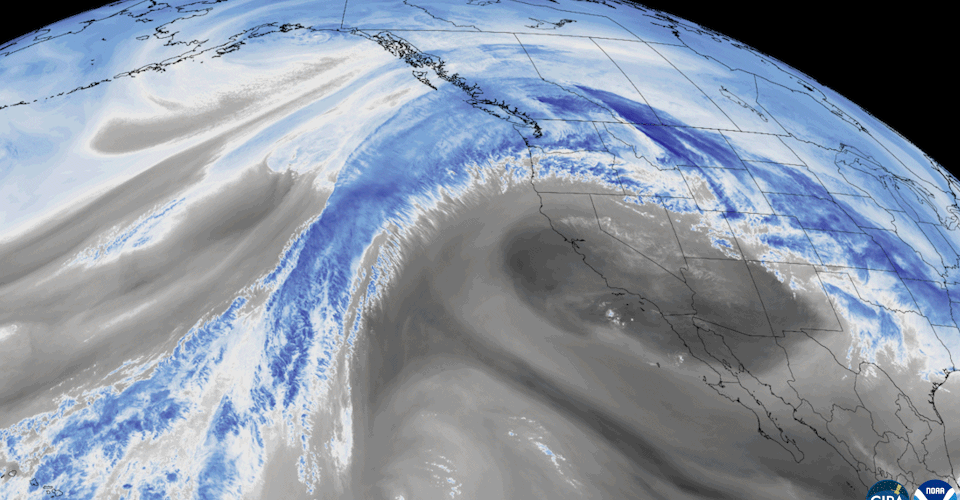
The complex phenomenon is captured in the GOES-West satellite image below. The image presents atmospheric water vapor in shades of blue, clearly highlighting the atmospheric river flowing from the Pacific, up and over the dry heat dome (shades of grey) in the Southwest.
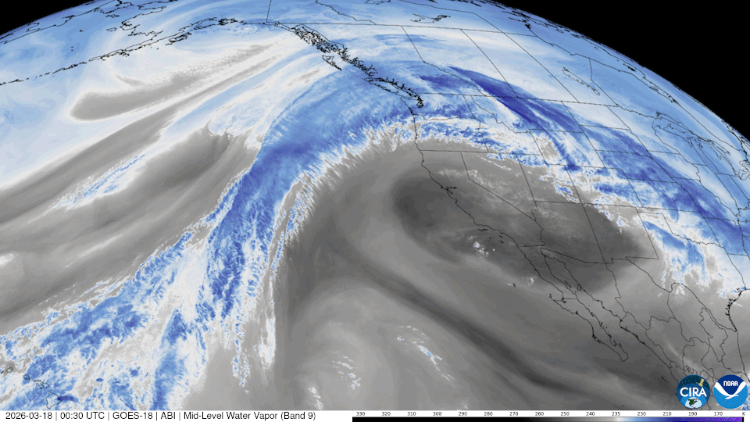
Figure 5: GOES-West water vapor image. Water vapor is shown in blue, with darker shades representing greater water content
The Climate Change Connection
“Virtually Impossible” Without Anthropogenic Climate Warming
Within days of the heat wave beginning, a team of researchers from World Weather Attribution (WWA), the consortium that conducts rapid scientific analyses of extreme weather events, published a striking conclusion: the temperatures experienced in the western United States in March 2026 would have been “virtually impossible without human-induced climate change“.
The WWA analysis compared March 2026 temperatures with historical data going back to 1900 and with computer models of a world without human-caused (anthropogenic) changes to the atmosphere. The study found that climate change added between 4.7°F and 7.2°F (2.6° to 4°C) to the temperatures being experienced. Analysis showed that without the added impact of climate change, the probability of such record-breaking events occurring is vanishingly small. To put it another way, such record-breaking events are virtually impossible without human-induced climate change.
Climate Central’s analysis told a similar story. The March 2026 heatwave received a Climate Shift Index (CSI) of 5, indicating that given the existing conditions, anthropogenic climate change made a heat wave event of this magnitude at least five times more likely to occur.
University of Victoria climate scientist Andrew Weaver summed up his thoughts on the Southwest heatwave thus: “This is what climate change looks like in real time: extremes pushing beyond the bounds we once thought impossible. What used to be unprecedented events are now recurring features of a warming world.”
Climate Models Are Underestimating the Trend
One critical finding from the WWA study is that even the most advanced global climate models (currently CMIP6) significantly underestimate the observed warming trend in heat extremes for this region. Observations show warming rates approximately triple the global average rate, a pattern also documented for Australia, Europe, and Central Asia. This means projections for future heat wave severity are likely too conservative.
A Climate Warming Backdrop
The 2026 heat wave did not materialize from nowhere. It is the most recent extreme expression of a decades-long, clearly measurable warming trend.
The World Meteorological Organization confirmed in January 2026 that the past 11 years have been the 11 hottest years on record. The three-year period from 2023 to 2025 was the hottest three-year stretch since temperature records began in 1850, averaging 1.48°C above pre-industrial levels. This was also the first time any three-year window has crossed the critical 1.5°C threshold set by the Paris Agreement.
The year 2025 alone registered a global average surface temperature of 1.44°C above the 1850-1900 baseline, ranking it as the third warmest year on record behind 2024 (warmest) and 2023 (second warmest).
Climate scientist Zeke Hausfather (Berkeley Earth, Carbon Brief) forecasts that 2026 will end up one of the four hottest years, although below the 2024 record. However, recent ENSO forecasts suggest that 2027 is increasingly likely to see a “Super El Niño,” which could well result in a 2027 global average temperature over 1.5°C.
The IPCC Warning: This Will Get Worse
Looking further forward, the Intergovernmental Panel on Climate Change (IPCC) Sixth Assessment Report (the most comprehensive scientific review of climate trends) states that it is “virtually certain” that “there has been increases in the intensity and duration of heatwaves and in the number of heatwave days at the global scale.” The IPCC also notes with “high confidence” that concurrent heat waves and droughts will continue to increase, creating compound risks that multiply harm across ecosystems, agriculture, and human health.
Cascading Consequences
Snowpack Collapse and Water Crisis
In the worst possible combination, the record shattering March heat wave in the Southwest followed right after the Snow Drought left by a record-warm 2025-2026 winter.
Climate Central reports that the amount of water stored in the 2026 western U.S. snowpack is currently the lowest on record for April 1, when it’s usually near the annual peak. At 65% below the 1991-2020 average, the snowpack is at its lowest level since 1981. For decades, western snowpack has been shrinking, peaking earlier, and accumulating over a shorter season — trends that are likely to continue as the climate warms.
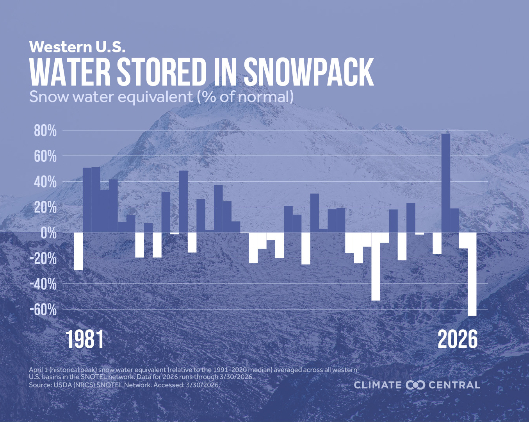
Figure 6: The steadily shrinking Western U.S. snowpack
The early and rapid snowmelt does not simply release the water earlier; it can cause runoff before storage capacity is available and lead to greater evaporative losses in the heat. This compounds the chronic water scarcity already straining the Southwest’s farms, cities, and ecosystems.
The consequences are exceptionally critical for the Colorado River Basin, which is the principal source of water for more than 40 million people across seven states, even though it has been mired in a multi-year “megadrought.”
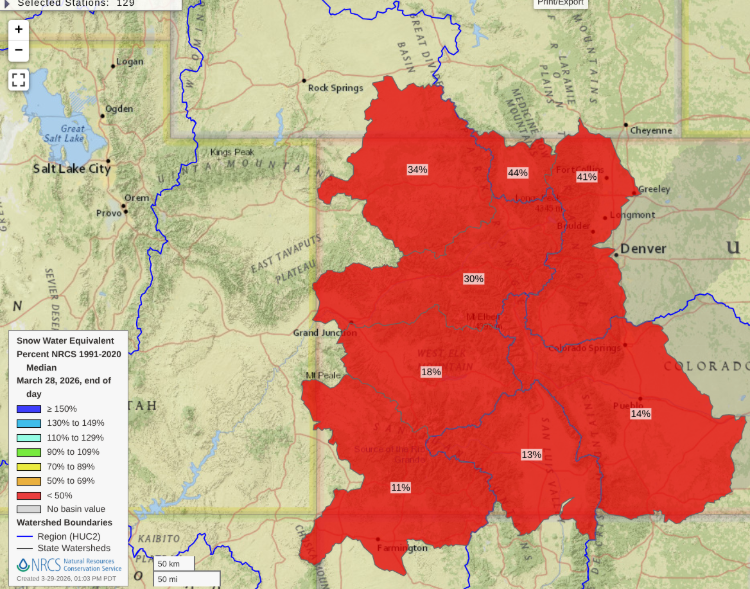
Figure 7: Colorado River Basin watersheds as of March 28, 2026. Total snow water equivalent in all of the watersheds is far below average.
In our recent review of the Southwest Megadrought, we pointed out that the water level in Lake Powell, the largest reservoir in the country, was dangerously low, approaching the critical elevation of 3,490 feet above sea level. Below that level, the Glen Canyon Dam can no longer safely generate hydroelectricity. As of April 1, 2026, Lake Powell is at 3,528 feet and conditions are deteriorating. Bureau of Reclamation managers warn that the reservoir could fall below 3,490 feet as early as August 2026.
Wildfire: A Longer, More Dangerous Season
Fire weather, a combination of hot, dry, and windy conditions, is one of the compound extreme events that will become more common and more severe in a warming climate. The March 2026 heat dome over the western and central U.S. checks all the boxes and adds the depleted Southwest snowpack that resulted from a warm, dry winter from the Rocky Mountains to California. As a result, the 2026 wildfire season is off and running.
As of March 27, 2026, The National Interagency Fire Center had logged 15,436 fires. Over the previous 10 years, the average number of fires by that date totaled 9,195.
A robust spring snowpack is critical for reducing drought and wildfire risk in the West. This year, a very sparse winter snowpack, coupled with record warm weather early in the year, will inevitably lead to low water levels in rivers and reservoirs, a dry landscape and the early arrival of drought and wildfire weather.
To make matters worse, a major marine heat wave has dominated the west coast since mid-2025. For 2026, climate models are increasingly suggesting the heat wave may be compounded by a “Super” El Niño, although that would likely not happen until late in 2026, continuing into 2027.
Figure 8, below, suggests that now is the time to start worrying about 2026 wildfires.
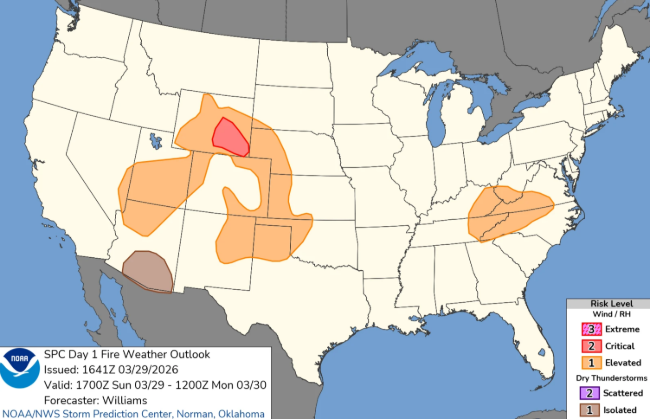
Figure 8: Storm Prediction Center Fire Weather product for March 29, 2026
Looking Ahead
The 2026 Southwest heat wave is happening in a global climate that is still (just) under the Paris Agreement proposed limit of a global average temperature 1.5°C above pre-industrial levels. However, the trend toward a much warmer climate seems inevitable. The IPCC has determined that at a global average of 1.5°C an increase in the number of heat waves is “virtually certain” on all continents. At 2°C, heat wave temperatures in the hottest mid-latitude regions could be warming at 1.5 to 2 times the global average rate.
The 2025 UNEP Emissions Gap Report concluded that the world is on a track to create a global average temperature rise of between 2.3°C and 2.8°C above pre-industrial levels over this century. Without extensive international action, those are the best results we can expect.
This means the 2026 Southwest heat wave is not an outlier, it’s a harbinger of things to come. Adaptation to the impact of climate change is more important than ever.